
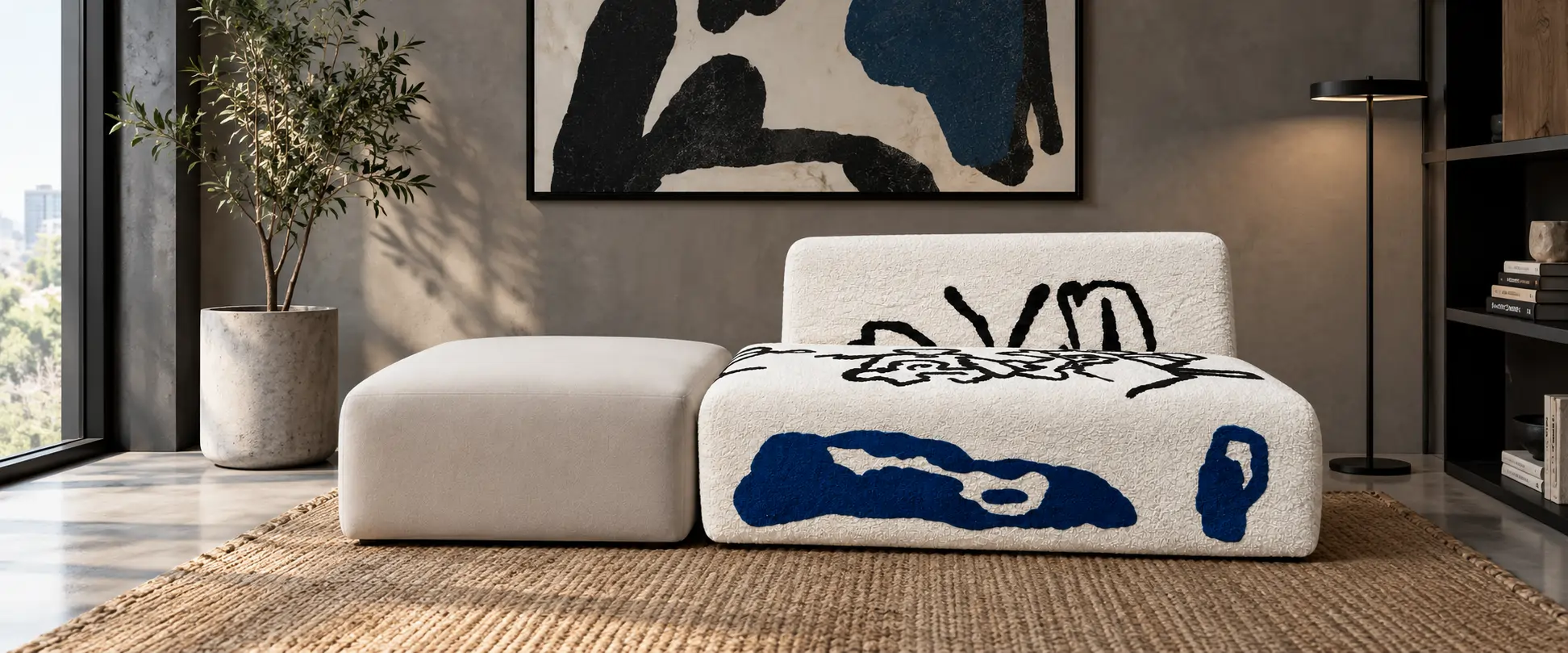
First there is a white surface.
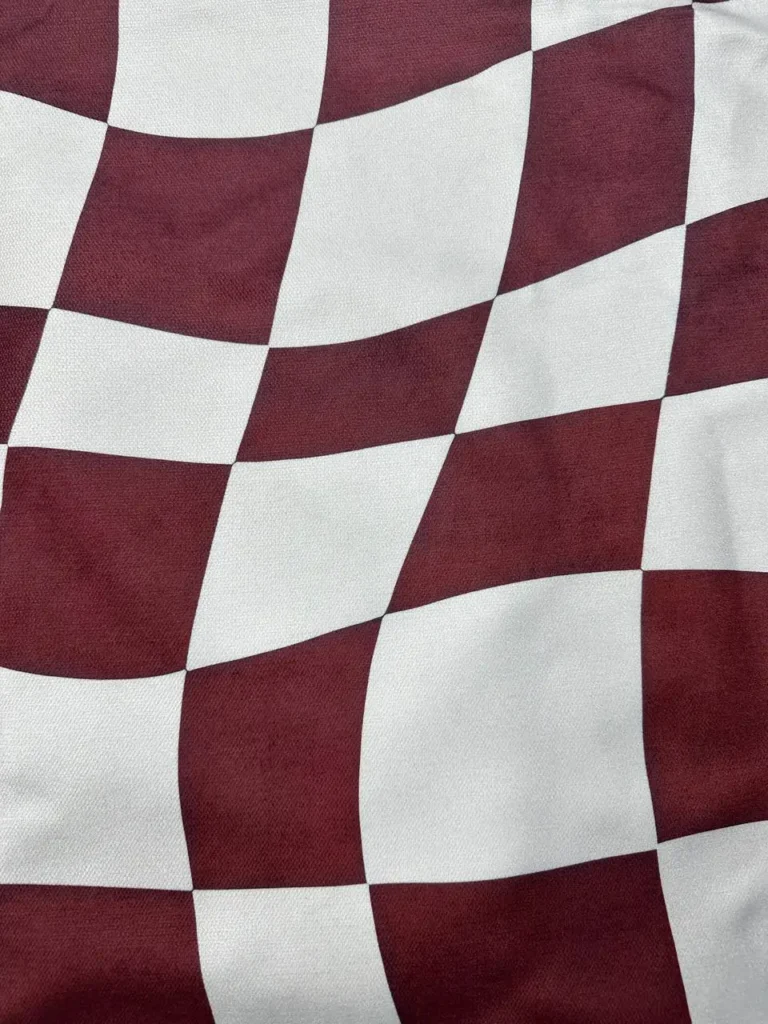
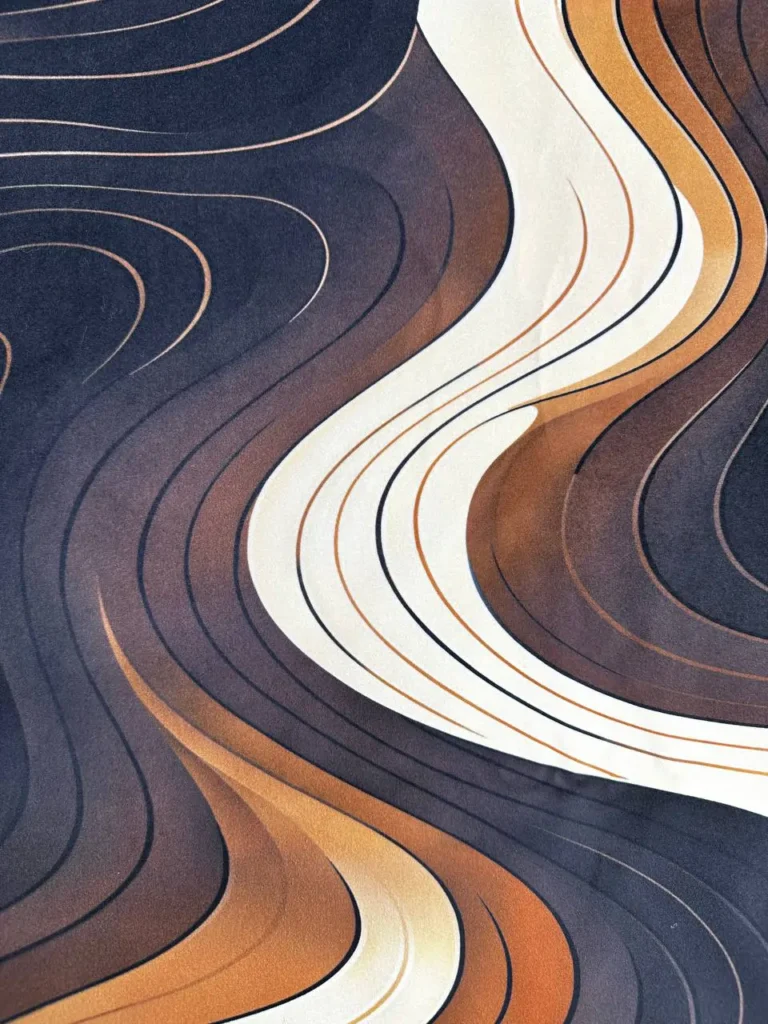
It says nothing yet. Just a soft plane, the light sliding over its texture, getting lost in the small irregularities and reappearing on the rounded edge. And then a black line appears on it. Behind it is a second. A blue stain takes up almost the entire lower part of the object, as if someone had made one broad stroke and decided not to correct it. On another fabric, a burgundy check suddenly refuses to be correct: the squares bend, stretch, move. Nearby, brown and cream streams flow in waves, as if wood, stone and liquid have become one material for a second.
And at this moment it becomes clear: the fabric is no longer a background.
She starts talking.
It was from this point that the idea grew, which we formulated on Instagram very simply: We transferred the art to fabric. Now you can sit on it.
Not a painting above the sofa. Not a decorative pillow that can be changed next season. Not a pattern added after the object has already been created. It’s about a different approach: the surface of the furniture itself becomes part of the design. An armchair, sofa, ottoman or headboard takes on its own graphics, color and rhythm – and together with the shape, they begin to work as a single object.
Graffiti on a chair? Paint splatters on a bench? Your own drawing on the headboard? It’s no longer a question of technical feasibility. The question is rather something else: How far are you willing to go with your idea?
To do this, at KAIZEN we have divided customization into three levels: Mono, Gallery and One of One. One leaves the form as pure as possible. The second introduces ready-made art into it. The third starts with a clean slate — your idea, a specific interior, and a print that won’t be found anywhere else.
And this is where custom furniture stops being just about “choosing a different color of fabric.” It becomes a tool with which you can create an object that belongs to a specific space, a specific person, or a specific brand.
Traditionally, fabric in furniture performs several clear functions: it covers the soft filling, provides the necessary tactility, withstands use, introduces color and helps the object integrate into the interior. We add another function — communication.
Fabric can tell a story.
It can transfer graphics that previously existed on paper to furniture. It can continue a motif from a painting. It can work with the identity of a restaurant or hotel. It can reproduce a drawing by an author, architect, apartment owner, or child. It can be built around a single color stroke, or it can turn the entire sofa into a large composition.
On the page KAIZEN art prints This logic already works as a separate direction: print is not considered an additional option after choosing furniture. It becomes one of the initial tools for designing an object.
This is a fundamental difference.
Imagine a white chair. If you just apply a random pattern to it, you get a white chair with a picture. But if you think about where the main line will go, what will happen to it at the radius of the back, how a large element will transition from the seat to the front, where to leave a clean plane, and where to increase the scale, the result will be perceived completely differently.
The drawing will start working together with the form.
That is why, in curved checkerboard patterns, the cell does not have to remain mathematically perfect. Its undulation supports the softness of the object. Abstract brown lines can repeat the direction of the rounded back. A large blue spot can occupy almost the entire front plane of the sofa, turning it into one broad graphic gesture.
This is no longer decoration.
This is a composition.
CUSTOM DESIGNED FURNITURE = SHAPE × FABRIC × COLOR × SCALE × PRINT PLACEMENT
Remove one component and the result will change.
Double the size of the image and the character of the subject will change. Move the main element from the center to the side and the compositional balance will change. Print the same file on a different texture and the visual density and tactility will change. Replace the white background with a cream background and the colors will interact differently.
This is the KAIZEN studio approach: looking not at the print in isolation and not at the chair in isolation, but at their interaction.
Not every interior needs maximum visual impact. And not every client wants furniture to immediately grab all the attention. That is why freedom of choice begins not with the question “what print?”, but with the question “how bold should this item be?”.
Mono is the calmest level.
You choose the model and the desired upholstery color. Here the main character remains the form itself: radii, proportions, fit, silhouette, legs, interaction with light.
A monotone does not mean a lack of individuality. On the contrary, a correctly selected complex shade or expressive texture sometimes works more precisely in a space than an active ornament.
Mono is needed where the architecture already speaks loudly enough or where the furniture should create a calm background.
Gallery is the next step.
We take one of the prepared KAIZEN compositions and transfer it to the selected model. The collection includes 10 art prints with different energies: organic lines, geometry, floristry, graphics, contrasting and calmer solutions.
A vivid example of how a print changes the character of the same form is OASIS armchair in various versions. The shape remains recognizable, but textiles can transform an object from a restrained lounge mood to an almost gallery-like art object.
Gallery is suitable for those who want a distinctive item but don’t need to develop graphics from scratch.
And then the rules change.
One of One does not have a ready-made solution that you just have to choose.
There is your idea.
It can start with a sketch in a notebook, a photograph, a fragment of a painting, a spot of color, an architectural motif, a pattern, text, a symbol, or even a feeling: “I want something like an old film strip” or “I need a print that looks like the movement of water.”
We translate this idea into a graphic system and adapt it to a specific subject.
One of One is custom-made furniture with a print created for just one project.
In this case, everything is thought out:
And after implementation, this print does not automatically become part of the serial collection. It remains part of a specific project.
| Level | What are we changing? | Level of individuality | For whom |
|---|---|---|---|
| Mono | Color and texture | Moderate | For clean, calm interiors |
| Gallery | Ready-made art print + base | High | For those who want a distinctive design accent |
| One of One | Print, palette, scale, composition | Maximum | For private, designer and branded projects |
All three levels have a right to exist. The main thing is not maximum complexity, but the accuracy of the solution.
In a digital file, graphics exist in two dimensions.
Furniture – three of them.
There is a moment between them where the real work begins.
A square may be flat on the screen. When it transitions to a rounded seat, its edges are visually distorted. A straight line running through the front radius begins to move. A large graphic spot on the back may look perfect from the front, but completely lose its meaning from the side.
Therefore, preparing a print for upholstered furniture is not limited to pressing the “print” button.
It is necessary to take into account the volume.
Look at the burgundy and white checkerboard. Its strength lies precisely in the fact that the classic chess structure has lost its rigor. The lines float a little. The geometry becomes elastic. If you transfer this pattern to a rounded shape, the effect is enhanced: it seems as if the object itself makes the pattern move.
Now another scenario is a wavy abstraction in chocolate, caramel, black and cream shades. There is no grid here. There is a flow. And the designer’s task is to decide where exactly the lightest wave will pass, where the dark zone will remain, how the lines will go along the back and what a person will see first when entering the room.
Graphics should work on the subject from every key angle.
This is especially noticeable in serial models, where one silhouette can be used as a platform for different stories. For example, OASIS with Wild Garden print demonstrates how a large floral pattern flows from the vertical backrest to the horizontal seat, but does not break up into random fragments. Scale and placement become part of the design.
It is at this stage that furniture begins to resemble working with canvas, only the canvas has radii, thickness, seams, and function.
A person will sit on it.
A child can walk by and wave their hand.
The guest will first see the side plane, not the front.
Daylight will highlight one fragment, and in the evening a lamp will highlight another.
The design must survive all these scenarios.
The same file never looks the same on different materials.
Smoother fabric makes graphics clearer. Lines appear thinner, color transitions are cleaner, and fine details are more visible.
A textured surface behaves differently.
It breaks the light into thousands of little shadows. The color becomes more physical. The line gets a jagged edge. The drawing begins to interact with the surface, not just lie on it.
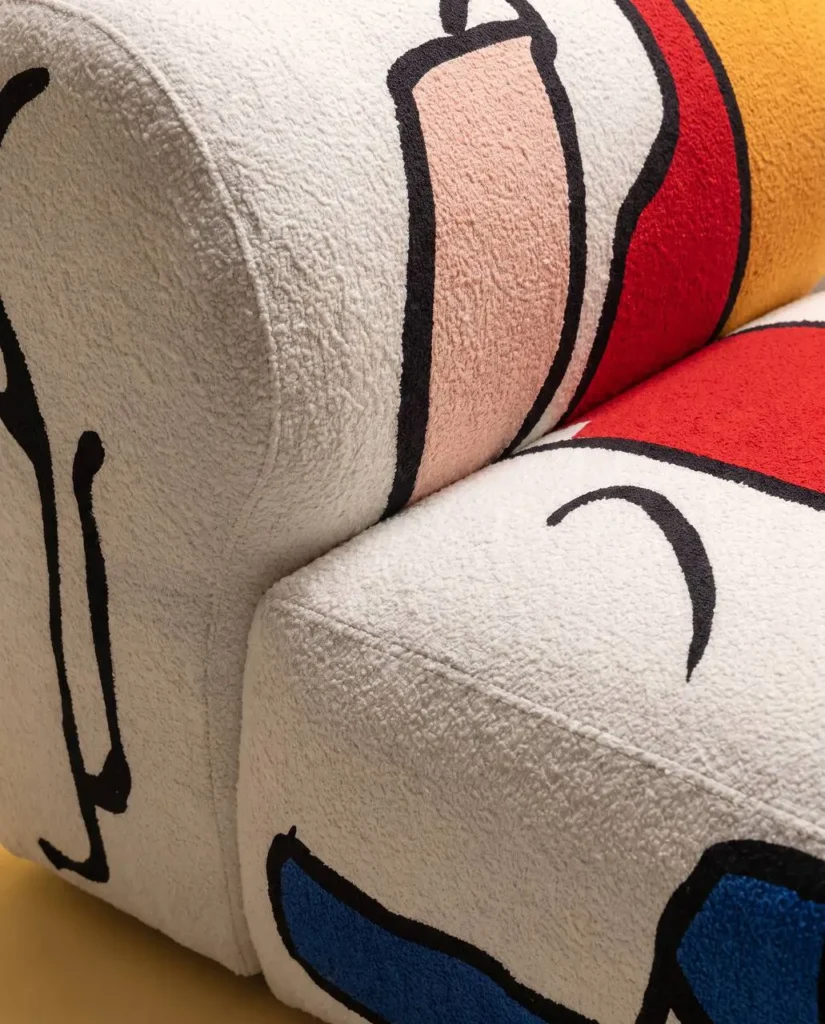
This is clearly visible in a large fragment with color graphics. The black outline does not exist in a vacuum — it runs along the embossed fabric. Red, powdery, and yellow colors repeat its texture. The seam cuts the composition, and the rounded edge changes the direction of the light.
This means that choosing a fabric based solely on the “feel” characteristic is not enough if we are working with a custom print.
It is necessary to evaluate the combination.
PRINT + TEXTURE = NEW SURFACE
Conditionally, the same graphic can become:
on a smooth base → more graphic and digital;
on the textured → more picturesque and tactile;
on soft pile → deeper and more variable in different light.
This is where the important principle of One of One comes in: the material is not selected after the design is complete. It is desirable to include it in the process immediately.
Color also cannot be considered in isolation.
A burgundy square next to pure white looks sharp and graphic. If you replace the white with a warm milky one, the composition will become softer. If you make the burgundy wine-colored, it will become more serious. If you turn it into a bright red, it will become more energetic.
It is through such small changes that the feeling of “this was made specifically for this interior” is created.
Not because someone wrote the word “custom”.
And because the color really matches the wood of the floor, the metal of the lamp, the shade of the stone, the textile of the curtains, or the artist’s work on the wall.
Individual design gives freedom. But freedom without a system easily turns into visual noise.
The most common mistake is trying to show all ideas on one subject at once.
Multiple colors, a large pattern, text, a symbol, a contrasting texture, a complex shape. Each element can be good on its own. Together they begin to compete.
Error: use the entire drawing without adaptation.
Decision: find a fragment or composition that works best on the shape of the furniture.
Error: Make the print small so that “everything fits.”
Decision: Feel free to scale up. One strong piece often works better than twenty small ones.
Error: ignore the seams.
Decision: include constructive lines in the composition before printing.
Error: select colors only from the screen.
Decision: correlate them with real interior materials and the texture of the base.
Error: make all surfaces equally active.
Decision: leave “quiet” areas that give the eye a rest.
Error: be afraid of large graphics.
Decision: evaluate the subject on a room scale, not just on a laptop screen.
One of the most interesting formats for large graphics is a sofa. Its planes give much more freedom, but at the same time require more precise composition. On the model EXOTIC The print can no longer be considered as a small accent, but as part of the architecture of a larger object.
A rule familiar from both graphic design and architecture works here: not everything has to be the main thing.
If a strong element is located on the front facade, the back can be made more calm. If the print is actively working on one sofa module, the next one can provide a pause. If the palette is bright, the form itself can remain as clean as possible.
To:
There is a standard furniture model and a separate beautiful image that you want to use on it.
After:
The image is transformed into a system: the scale is determined, a fragment is selected, a palette is formed, the drawing is decomposed into pattern details, radii, seams, and main points of view are taken into account.
That’s when not just furniture “with a picture” appears.
Custom-made designer furniture is emerging.
For a private client, One of One is an opportunity to receive an item that no one else has.
For the designer, this approach solves another problem: it allows you to create furniture that does not have to be adjusted to a ready-made concept.
They can be designed together with it.
Imagine a hotel. It already has an identity, a palette, graphic motifs, perhaps a local history. Instead of a standard chair in the lobby, you can create an object that captures part of this visual code.
In a restaurant, the print can repeat the menu graphics or the artistic concept of the space.
In the salon, work together with branding.
In a residential interior, it can be a continuation of a larger picture or, conversely, the only bold element in a restrained space.
In a corporate project, convey the character of the company without a direct logo.
That is why the direction KAIZEN for designers logically connected to the idea of One of One. What is important here is not just the ability to “make a different color”, but working together on the subject as part of a holistic project.
This opens up several possibilities for the designer:
However, corporate customization does not mean that you need to print a logo on every sofa.
Vice versa.
The most interesting branded interiors often work more subtly. They take the character of the brand—its rhythm, palette, plasticity, energy—and translate it into object design.
If the company is associated with technology, the print can be graphic and structural. If with naturalness, organic. If it is a fashion space, you can work with large, bold compositions. If it is a premium service, you can work with minimal graphics and complex textures.
This is no longer branded merch on the scale of an armchair.
This is interior identity.
And this is where the studio approach is of the greatest importance: the manufacturer, designer, and customer do not work sequentially one after the other, but form solutions together.
As Masaaki Imai succinctly put it:
“Kaizen means improvement.”
For us, this describes the very principle of customization well: not adding more for the sake of effect, but consistently fine-tuning an object to its future environment.
The most interesting part does not start with the choice of fabric.
And from the conversation.
Sometimes a client comes with a finished drawing. Sometimes, just photos of the interior. Sometimes, there’s a moodboard. Sometimes, there’s a phrase: “I want something bold, but without bright colors.” Or an old postcard that you want to turn into a pattern. Or an artist’s graphic that you need to adapt.
We don’t need a perfectly prepared file to get started.
Need an idea.
Further, the process can be conditionally divided into six steps.
As a result, furniture with an individual design acquires an important property: it is difficult to imagine it in another place.
It’s like they were always meant to be here.
Next to this table.
Against this wall.
In this light.
For this project.
This is the main difference between a mass-produced product with lots of options and a truly personalized item.
Let’s go back to the first scene.
Light fabric. Black line. Large blue spot.
Now we see more than just a picture.
We see the scale decision. We understand that the line must pass through the volume. We know that the texture has affected its edge. We notice where the composition has left air and where it has become denser. And we start to look at the furniture a little differently.
What if a chair could be more than just “beige” or “blue”?
What if the headboard could contain your graphics?
What if the sofa becomes the largest painting in the room—just a painting you can lie on?
What if a designer’s drawing doesn’t end in a frame on the wall, but continues in textiles?
This is what the Instagram post was about: “We transferred art to fabric.”
This is not a metaphor for the sake of a pretty phrase. This is literally the way we work with furniture.
Mono leaves a clean form.
Gallery gives you the opportunity to enter the world of ready-made KAIZEN prints.
One of One opens up a different scenario — when the starting point is no longer our collection, but your idea.
And there is no required level of courage here.
Your subject can be almost monochrome, with a barely noticeable graphic line.
Or you might get a huge fragment of the painting.
Can continue the interior palette.
Or maybe he deliberately argues with her.
Could be one accent chair.
Or it can become a furniture system for an entire commercial space.
The main thing is that the decision is conscious.
Therefore, the final question remains the same as the one that begins One of One:
What would you bring to your chair?
You can start without even having to write a technical specification. Send it to Direct a drawing, reference, interior photo or simply describe your idea. Then we can break down the idea into color, texture, scale, composition and understand what your custom-made furniture with print.
And the Instagram post that brought you here can be left next to this article as the first point of the route: first the image and the question, then the process, the material, and the object that will exist only in your project.